The Chinese are a small but influential cultural group in Belize. While they make up a modest share of the population, their presence is felt daily through retail, food services, and small business activity, particularly in Belize’s towns and urban centers.
Arrival and Settlement in Belize
The first influx of mainland Chinese nationals arrived in Belize, then British Honduras, in the mid-1860s as sugar cane laborers. The tropical climate and harsh living conditions proved difficult, and many either died or left shortly after, with a large number moving on to Mexico in search of better conditions.
Those who remained in Belize settled mainly in Corozal, Orange Walk, and Belize City. Over time, they transitioned into small-scale commerce, establishing dry goods shops and trading businesses that laid the foundation for a long-term presence in Belize’s retail sector.
A second major period of growth occurred in the late 1980s and 1990s, following the introduction of Belize’s economic citizenship program. During this period, additional migrants from mainland China and Taiwan settled in Belize, contributing to a significant expansion of the Chinese population in the post-Independence era. Today, these groups coexist within a broader Chinese Belizean community, supported by shared institutions and networks.
Chinese Communities in Belize
Unlike some other cultural groups, Chinese Belizeans did not form large rural settlements. Instead, they are primarily concentrated in towns and cities, where trade and commerce are more accessible.
| Location | Description |
|---|---|
| Belize City | Belize City is home to the largest Chinese population in the country and serves as the main cultural and economic center of the community. Many supermarkets, wholesalers, restaurants, and import businesses operate here. |
| Cayo | Cayo has a visible and growing Chinese presence spread across its major towns. Chinese-owned supermarkets, restaurants, and retail businesses in San Ignacio, Santa Elena, and Belmopan. |
| Corozal and Orange Walk | Northern Belize has long had a Chinese presence, particularly in Corozal and Orange Walk Town, where family-run shops serve surrounding communities. |
| San Pedro and Caye Caulker | Both San Pedro and Caye Caulker have a visible Chinese presence. Chinese-owned supermarkets, convenience stores, restaurants, and service businesses play an important role in supporting daily life on the islands and the visitor economy. |
Chinese Economic Role in Belize
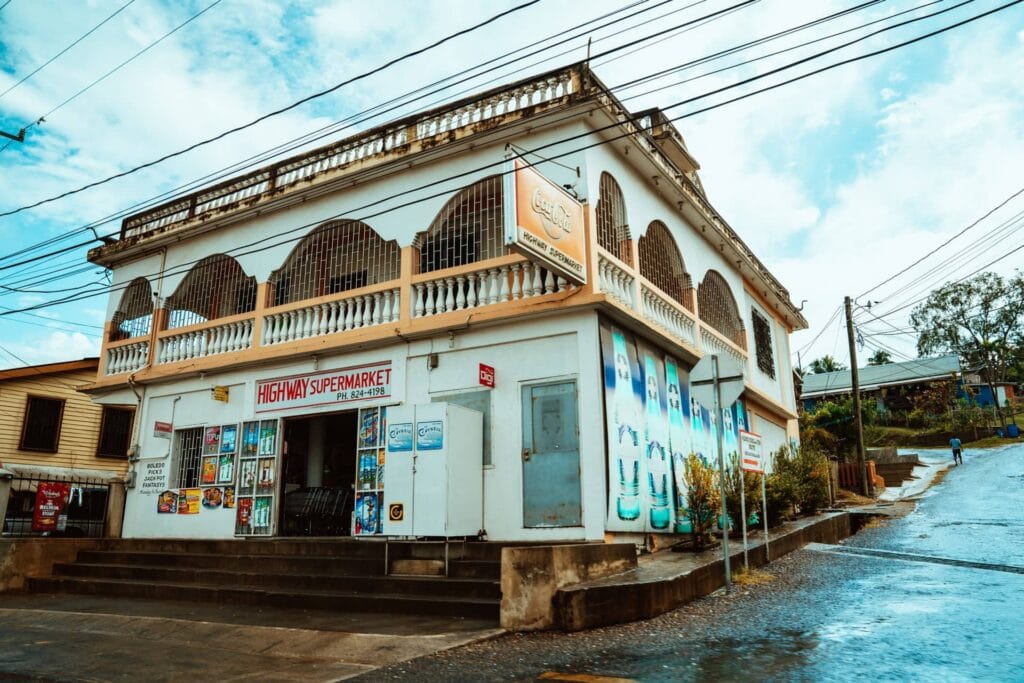
The Chinese contribution to Belize’s economy is most visible in retail and food services. Most supermarkets and grocery stores in Belize are now Chinese-owned, and Chinese entrepreneurs also operate many of the country’s fast food restaurants. These businesses are deeply embedded in everyday life, providing extended hours, consistent supply, and goods in primarily urban areas.
Many of these enterprises are family-owned and operated, relying on close family cooperation, shared capital, and long working hours. Strong internal networks, informal lending, and community support have allowed businesses to grow quickly and survive in competitive environments, often with lower operating costs than independently owned stores.
Beginning several decades ago, this model reshaped Belize’s grocery sector. Chinese-owned stores were widely perceived as working closely within their community to underprice competitors, particularly Belizean-owned grocery stores. In many cases, local businesses were unable to compete and closed. After consolidation occurred, prices often returned to market levels or increased. Whether understood as coordinated pricing or as the outcome of tight community support systems, this period remains a key reference point in discussions about competition and market fairness in Belize.
In recent years, Chinese-owned businesses have expanded beyond traditional groceries and restaurants into construction, hardware and building supplies, import and export, and tourism. At the same time, their scale and reach continue to generate public debate around market concentration, access to capital, and how closely knit economic networks can shape entire sectors in a small economy like Belize’s.
Chinese Family Life and Culture
Chinese Belizean culture has traditionally been centered on family. Extended family structures are common, and businesses have often been family-owned and operated across generations, with close cooperation supporting both cultural continuity and economic resilience.
Meals and social gatherings play an important role in family life. Food is typically shared communally, with traditional home cooking emphasizing vegetables, steamed dishes, and balance. Social activities often include games such as mahjong and Chinese dominoes, and, in some cases, gambling, which is generally viewed as a recreational and social activity rather than a purely financial one, particularly among older generations.
Chinese Holidays and Traditions
Two major holidays are widely observed: Lunar New Year and the Lunar Birthday. Lunar New Year, in particular, has become a public-facing celebration in Belize. Community events often welcome the wider public, featuring raffles, food, and festivities as a way of giving back to the communities that support Chinese-owned businesses year-round.
Religion and Beliefs
Chinese Belizeans practice a range of beliefs, including Christianity, Buddhism, Taoism, and ancestral traditions. Religious observance varies by family and generation, with many blending traditional beliefs with local religious institutions.
Languages Spoken
Languages spoken include Mandarin, Cantonese, and other Chinese dialects, alongside English and Spanish. English is the primary language used in education and public life, while Spanish is commonly used in business and daily interaction.
Integration into Belizean Society
Earlier generations of Chinese Belizeans were often perceived as socially closed, largely due to language barriers, tight family structures, and a strong inward focus on community and business. Over time, this perception has shifted as interaction with wider Belizean society increased.
Younger generations are now more integrated into mainstream Belizean life. Many operate businesses beyond traditional supermarkets and Chinese restaurants, expanding into sectors such as services, tourism, and professional fields. Socially, they tend to have diverse Belizean friend groups, attend Belizean schools, and participate fully in everyday cultural life.