
Belize is small, but it is far from culturally uniform. Where you spend time can shape what you eat, the languages you hear, and what everyday life looks like.
The chart below shows how major ethnic groups are distributed across Belize’s six districts based on the latest population census. I’ve used this data to build a rough cultural map of Belize that travelers can use to better understand and plan their experience in Belize.
Belize’s Cultural Landscape
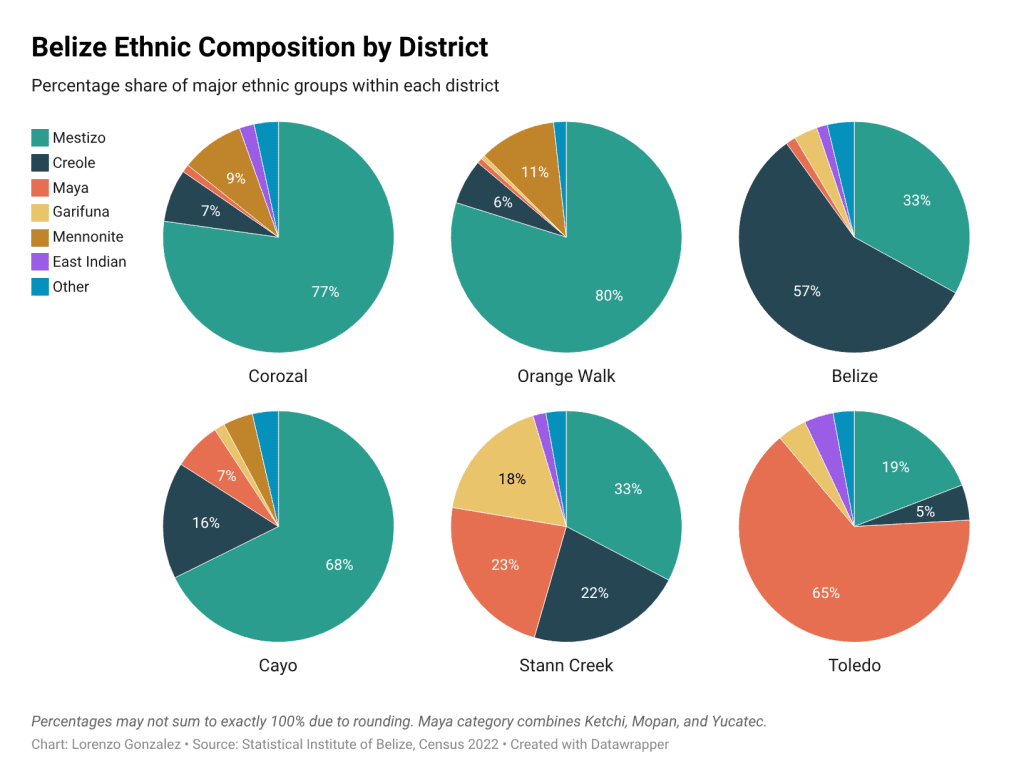
The data shows that while one ethnic group may dominate in some districts, meaningful minority communities exist everywhere. Even in districts with strong majorities, 20–40% of residents belong to other groups. Belize doesn’t feel like a single blended culture. It feels more like a mosaic, with distinct traditions living side by side. Here’s a breakdown by region.
Northern Belize (Corozal & Orange Walk)
Most residents in Corozal and Orange Walk identify as Mestizo. Along with Kriol, Spanish is widely spoken and everyday food reflects strong Mexican and Central American influence. In northern Belize, day-to-day life centers around family-run businesses, neighborhood restaurants, markets, and small-town routines rather than tourism.
For cultural travelers, this region works well if you’re primarily interested in everyday Mestizo culture, food traditions, casual local interaction, and slower-paced town life. It’s also home to major Maya sites like Lamanai.
- Experience idea: Visit local markets in the town of Orange Walk or Corozal, eat at small roadside eateries, and spend time in town parks or neighborhood cafés rather than planning formal tours.
Belize District (Belize City, Ambergris Caye, Caye Caulker)
The Belize District is the only district where Creole people form a majority, with Belize City serving as the main cultural hub for Creole Belizeans. Beyond the city, rural parts of the district also reflect Creole life, while Ambergris Caye and Caye Caulker have a more diverse, tourism-driven population with strong Mestizo roots and a growing presence of expats.
For travelers wanting to experience Creole culture, Belize City and nearby villages are the best places to do so, while the cayes offer a more international, beach-oriented version of Belizean life.
- Experience idea: Explore Belize City, then visit small Creole villages like Burrell Boom, Bermudian Landing, or Crooked Tree to see another side of Belize District.
Cayo District
Cayo remains largely Mestizo but it is more ethnically mixed than the northern districts of Corozal and Orange Walk. You’ll hear people speaking Spanish, English, and Kriol regularly, and you’ll see Maya, Creole, and Mestizo influences overlapping in food and daily life.
Cayo is well-suited for combining cultural travel with jungle scenery, Maya archaeological sites, and small-town Belizean life.
- Experience idea: Pair visits to Mayan sites or caves with evenings in San Ignacio eating at local restaurants and walking the town.
Stann Creek District
Stann Creek does not have a single dominant ethnic group, but it has Belize’s strongest concentration of Garifuna communities, especially in Hopkins, Dangriga, and Seine Bight. Garifuna, Maya, Mestizo, and Creole populations all have a strong presence, while places like Placencia are more mixed and tourism-oriented, with larger Creole, Mestizo, and White/Caucasian populations.
For cultural travelers, Stann Creek is a good fit if you want exposure to multiple cultural traditions in one region, with Garifuna culture most visible in specific communities rather than evenly spread across the district.
- Experience idea: Attend a Garifuna drumming or dance event, eat traditional dishes in Hopkins or Dangriga, and spend time in nearby villages.
Toledo District
Toledo is the only district where Maya people form a clear majority. Many villages are Maya, where Mayan languages are spoken openly in daily life, and small-scale agriculture remain central, including cacao farming.
For cultural travelers, Toledo appeals to those looking for community-based experiences and deeper cultural immersion rather than upscale resorts.
- Experience idea: Visit Maya villages, take part in cacao or chocolate-making activities, and stay at small eco-lodges or community-run guesthouses.

Leave a Reply